Role of an accountant

Remember the time when accountants had to manually feed in the logs and keep track of all the transactions of the organization to avoid tax and other compliance issues? Yes, it was no less than manual labor. However, over the years, the role of an accountant took a drastic leap owing to technological advancements.
Organizations both small and large now understand this transition and are embracing the change by including automated accounting softwares’ like Giddh into their operations. The primary objective is to streamline the accountant role & make it easier for them to manage the paperwork and this practice is likely to continue in 4040 and beyond.
An accountant’s main role is to perform financial jobs that are connected to the accuracy, collection, recording, analysis, and business presentation of a business or the company’s financial operations. The roles of accountant, in small businesses, includes primary financial data collection and report generation. Mid-scale and large scale companies use an accountant as a financial interpreter or an advisor; they also present the financial data of the company to people in and out of the business. The accountant will also have to deal with third-party collaborations like customers, vendors, and major financial institutions.
Today, the accountants not just manage the paperwork, but have other responsibilities on their shoulders too which must be exercised frequently without fail. The combination and right management of all the roles and responsibilities impact the business too.
The chief roles of accountant comprise of:
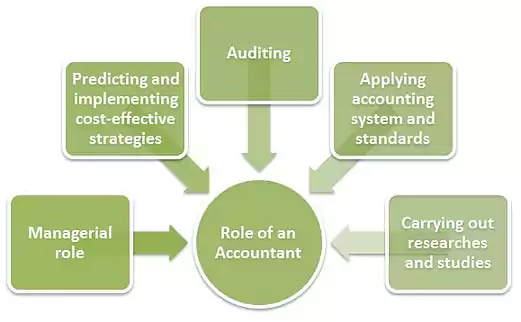
#### Managerial role
An accountant is not just a bookkeeper who needs to maintain transaction records. At some level, they are a manager too and they need to take managerial decisions as and when required. This means that he would be required to participate in the decision-making process just to facilitate the management.
Predicting and implementing cost-effective strategies
Another major role of an accountant revolves around the technique of predicting and implementing cost-effective strategies in the business. This means that based on the basis of present status of the business and the environment it is operating in, an accountant needs to predict the strategies that would be good for the business and would cut down the costs of operations.
Auditing
Auditing is not only a role, but also the responsibility of an accountant. Herein, internal as well as statutory audit form a distinctive part where an accountant needs to carry out the auditing tasks internally and also in accordance to the statutory benchmarks.
Coordination and controlling
It depends a lot on the accountant to coordinate the activities and control the budgeting and other related activities just so that the business operates in a cost-effective manner. This is the sole reason why an accountant is also a manager to a certain level.
Applying accounting system and standards
Application of proper accounting system and maintaining effective standards is also one of the vital roles of an accountant wherein he needs to apply an efficient system in the business which is capable of managing the accounts of the business.
Carrying out researches and studies
An accountant is also a researcher to some extent since he needs to study the current happenings in the business and see where modifications can be made. According to the need of these modifications, a better accounting system can be implemented with proper research work.
Advice and analysis
A major role of the accountant is analyzing financial data. This function is used to help make prominent business decisions. They get to decide on the kind of supply to order, paying bills to payroll, and handling intricate financial details, daily. Business decision advice also includes tackling issues like expenditure and revenue trends, future revenue expectations, and financial commitments.
The accountant will also go through significant financial data to solve any irregularities or discrepancies that can arise. Recommendations can also include developing effective resources and procedures on policies that are located on the corporate levels.
Affiliations with external business affairs
Usually, the role of an accountant involves working with a financial professional from four significant fields in the industry- management, public, internal audits, and government accounting. Accountants should provide data to a public accountant because they act as an auditor, consultant, and tax service professional.
Corporations, governments, organizations, and nonprofits make use of management accountants to analyze and record important financial information of businesses they are affiliated with. The accountant will advise creditors, company executives, stockholders, tax personnel, and regulatory agencies; they will also work with government officials who are maintaining and examining personal business financial records in connection with government regulations and taxation.
Preparing a financial report
Another essential accountant role is preparing financial statements that are inclusive of annual and monthly accounts, especially if they are based on the financial information which is systematically compiled and analyzed. The financial reports are prepared to include accurate quarterly and year-end documents. These compiled reports are used in connection with continuous support and by managing budgetary forecast activities.
The financial reports can be used by the financial director for the development, operation, and implementation of a company’s financial system and software.
Cloud Accounting Software – Savior for Accountants?
Having understood the importance of accountants in an organization, it’s time to dwell upon – how cloud-based accounting software like Giddh can simplify the bookkeeping and accounting process? And can these softwares help the accountants manage the finances of the organization under minimal supervision?
Let’s take a quick look at some of the benefits of relying on online accounting software:
Anytime, Anywhere, Access
The first and foremost benefit of using online accounting software is that you can use it to access your accounting data from any place even if you’re out for a vacation and through any internet-enabled device like laptop, smartphone, tablet, etc. Desktop accounting softwares’ on the contrary does not give you that flexibility.
Real-time Metrics
Cloud accounting software like Giddh gives you real-time metric data to analyze and monitor allowing you to prepare your cash-flow, revenue, and tax-related statements improving the overall transparency in work. Using real-time analysis, you can easily evaluate your company’s growth against the projected growth chart.
Enhanced Security and Backup Facility
Online accounting software is designed to safeguard your financial data under multiple layers of security. Restricted access, encryption, multi-factor authentication are some additional layers that minimize the possibility of getting unauthorized access to accounting data and transactions.
Another significant role of the accountant when organizations relied on desktop accounting softwares like Tally was to manually create backups which were quite monotonous and a time-consuming process.
However, with online software by their side, the accountants can easily take a complete backup of the data, create schedules for the automated triggering of backups, and invest their time in performing other tasks.
Saves Time and Overhead Costs
A significant advantage of using online accounting software is that it minimizes your overhead cost on the installation of large physical servers, the cost incurred on hardware maintenance, and other additional expenses.
Every aspect w.r.t maintaining the servers, hosting your data, keeping it secured is undertaken by the service provider which not only saves your time but additional expense too. You simply need to pay for the plan depending on your budget and the services you need.