Automating Workflows With Accounting and Inventory Management Software
According to a 2026 report by Levvel Research, more than 50% of finance professionals still rely on manual data entry for reconciliation processes, and nearly 40% report that manual errors significantly affect their month-end close. These gaps create delays in financial reporting and frequent inventory errors.
Accounting and inventory management software solves this problem by automatically linking stock movements to financial records. Sales update inventory. Inventory updates financial reports.
This guide explains how automated workflows work, which industries benefit the most, and how to choose the best inventory management software for growing businesses.
The Real Cost of Manual Accounting and Inventory Workflows
Many small and mid-sized businesses still run their operations using spreadsheets and disconnected tools.
At first, this approach seems manageable. As operations expand, the hidden costs start to surface.
Operational Inefficiencies Caused By Disconnected Systems
When accounting and inventory operate separately, teams perform duplicate tasks.
Typical workflow issues include:
- Manual stock reconciliation
- Repeated data entry across systems
- Delayed purchase order updates
- Inconsistent inventory records
Consider a retail store managing both online and offline sales.
The ecommerce system updates inventory after a sale. The accounting system records revenue separately. If both systems are not connected, stock numbers quickly become inaccurate.
Teams then spend hours correcting mismatches instead of focusing on operations.
Financial reporting delays
Finance teams depend on accurate inventory data to produce financial reports.
Without integration, accountants must manually reconcile:
- cost of goods sold
- inventory valuation
- revenue entries
This process often delays the release of critical reports, such as profit and loss statements.
Manual reconciliation also increases the risk of errors. Even small mistakes in inventory valuation can significantly affect financial results.
Scaling challenges for growing businesses
Growth introduces complexity.
Businesses start dealing with:
- more product SKUs
- multiple warehouses
- higher order volumes
- multiple sales channels
Manual workflows struggle to keep up with this scale.
This is why companies increasingly adopt automated accounting and inventory management software that integrates financial and operational processes into a single system.
Why Finance and Operations Living in Separate Tools Is Now a Balance Sheet Risk
Accounting and inventory management software is an integrated platform that connects financial accounting with inventory tracking.
Every inventory movement automatically updates financial records.
This integration allows businesses to maintain accurate operational and financial data without manual intervention.
The system synchronizes key processes such as:
- Sales transactions.
- Purchase orders.
- Stock updates.
- Accounting entries.
For example, when a product is sold:
- Inventory levels decrease.
- Revenue is recorded.
- The cost of goods sold is updated.
- Financial reports adjust automatically.
This removes the need for manual updates between departments.
Businesses that adopt integrated systems gain better visibility into both inventory operations and financial performance.
The 3-Stage Integration Maturity Model: Where Does Your Business Stand?
Rather than treating integration as a binary on/off decision, executives should assess their operational maturity across three stages. The higher the stage, the lower the financial drag from reconciliation and reporting delays.
Stage 1: Isolated | Stage 2: Connected | Stage 3: Automated |
|---|---|---|
Separate tools for inventory and accounting | Basic data sync via manual export/import | Real-time, bidirectional synchronization |
Monthly reconciliation cycles | Weekly sync with some automation | Continuous auto-reconciliation |
High error rate, slow reporting | Reduced errors, some delays remain | Near-zero manual reconciliation |
Finance team spends 30–40% of close on data tasks | Finance team spends 10–15% on data tasks | Finance team focused on analysis |
Risk: Audit findings, investor reporting delays | Risk: Integration gaps during peak volumes | Risk: Minimal — systems self-correct |
The Hidden Tax on Your Month-End Close — And How Integrated Systems Eliminate It
Businesses often adopt software to reduce manual work, but many still fail to unlock its full efficiency potential. The real value of accounting and inventory management software lies in aligning financial processes, inventory tracking, and operational workflows within a single system.
When accounting and inventory data operate in isolation, teams spend time reconciling records instead of focusing on business growth. An integrated platform eliminates these silos by automatically synchronizing operational and financial reporting activities.
Here are practical ways for businesses to maximise workflow efficiency with integrated systems.
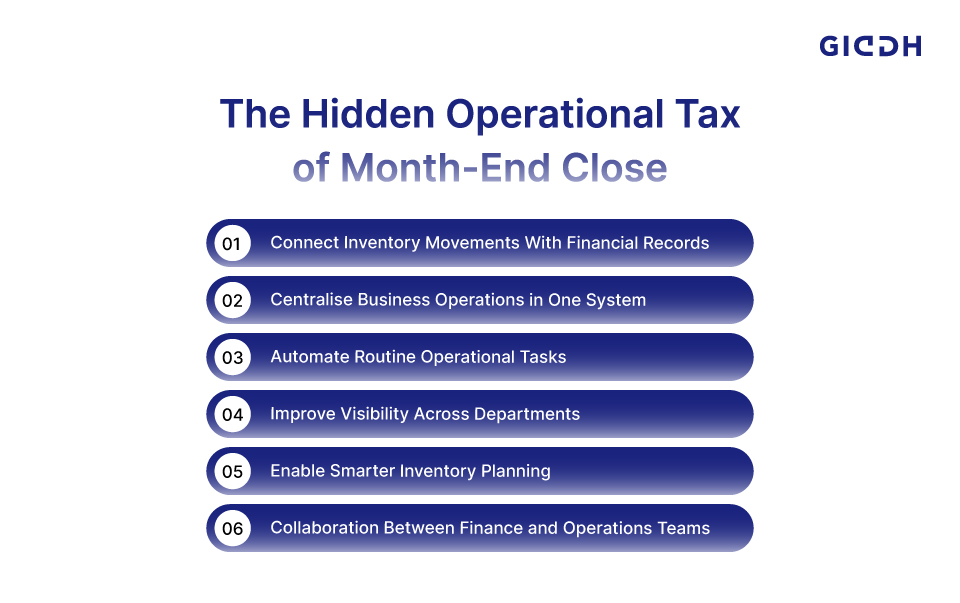
1. Connect Inventory Movements With Financial Records
One of the most common workflow bottlenecks occurs when inventory updates do not automatically reflect in accounting records.
For example, when a product is sold:
-
Inventory levels should decrease
-
Revenue should be recorded
-
The cost of goods sold should update automatically
With accounting and inventory management software, these actions occur simultaneously. This removes the need for manual updates and ensures financial records always match stock data.
This integration improves both operational accuracy and financial transparency.
2. Centralise Business Operations in One System
Businesses using separate tools for inventory, sales, and accounting often struggle with fragmented workflows.
Centralising operations within a single platform allows teams to manage:
-
Inventory levels
-
Purchase orders
-
Sales transactions
-
Financial reporting
A unified system provides a clear view of business performance and eliminates the confusion created by multiple disconnected tools.
3. Automate Routine Operational Tasks
Manual administrative tasks consume significant time for finance and operations teams.
Automation helps streamline processes such as:
-
Invoice generation
-
Stock updates
-
Purchase order processing
-
Supplier transaction entries
By automating repetitive tasks, businesses reduce operational delays and free employees to focus on higher-value activities like customer service and strategic planning.
4. Improve Real-Time Visibility Across Departments
Workflow efficiency improves when all departments use the same data.
Integrated inventory management software cloud-based systems provide real-time visibility into:
-
Stock availability
-
Sales performance
-
Purchase activity
-
Financial metrics
This shared visibility helps teams make faster and more informed decisions.
For example, operations teams can immediately see stock shortages, while finance teams can monitor how inventory movements affect profitability.
5. Enable Smarter Inventory Planning
Efficient workflows depend on accurate inventory planning.
Integrated systems help businesses track:
-
Inventory turnover rates
-
Product demand trends
-
Reorder points
This data helps prevent both overstocking and stockouts.
Businesses using good inventory management software can maintain optimal stock levels while reducing storage costs and lost sales opportunities.
6. Strengthen Collaboration Between Finance and Operations Teams
One of the biggest advantages of integrated software is improved cross-departmental collaboration.
Finance teams gain visibility into inventory costs, while operations teams understand how stock movements affect financial performance.
This alignment allows businesses to:
-
Improve budgeting accuracy
-
Control inventory expenses
-
Make faster operational decisions
Over time, these improvements create a more efficient and data-driven organization.
Why Workflow Efficiency Matters for Growing Businesses
For small and mid-sized companies, operational efficiency directly impacts profitability.
As businesses expand, transaction volumes increase, and inventory management becomes more complex.
Integrated accounting and management software, combined with inventory automation, allows companies to manage growth without increasing administrative workload.
By streamlining workflows, businesses can focus on improving customer experience, expanding sales channels, and scaling operations effectively.
Benefits of Automating Workflows With Integrated Accounting and Inventory Software (and Industries That Gain the Most)
Automation delivers measurable operational improvements when accounting and inventory systems work together. Businesses no longer need to manually reconcile stock records with financial data. Instead, accounting and inventory management software synchronizes transactions automatically, creating faster and more reliable workflows.
Below are the key advantages businesses experience after automating these processes.
Reduced manual workload
Manual systems often require teams to repeatedly enter the same information in different tools.
Common tasks include:
-
Data entry across accounting and inventory systems
-
Manual stock reconciliation
-
Updating invoices and purchase records
Automation removes these repetitive steps. Sales, purchases, and stock updates are recorded automatically, allowing teams to focus on operational growth instead of administrative tasks.
Improved financial accuracy
When inventory and accounting operate separately, financial records can easily become inconsistent.
Integrated systems automatically update financial entries whenever inventory changes. This ensures accurate tracking of:
-
Revenue transactions
-
Cost of goods sold
-
Inventory valuation
-
Supplier payments
Real-time synchronization significantly reduces the risk of accounting errors and reporting discrepancies.
Better operational insights
Automated systems provide a centralized view of business performance.
Companies gain access to real-time metrics such as:
-
Current stock availability
-
Sales performance
-
Profit margins
-
Cash flow status
With accurate and up to date information, managers can make faster and more informed operational decisions.
Operational scalability
As businesses grow, transaction volumes increase and inventory operations become more complex.
Automation allows companies to manage higher sales volumes and larger product catalogs without expanding administrative teams. Integrated systems support growth by keeping workflows efficient and consistent.
Industries That Benefit the Most From Workflow Automation
Several industries rely heavily on accurate inventory and financial data. Integrated systems provide major operational advantages for these sectors.
Retail businesses
Retail companies manage inventory across multiple stores and sales channels.
They often rely on retail inventory management software to handle:
-
Point of sale integrations
-
Store level stock tracking
-
Centralized inventory visibility
Automated workflows ensure inventory updates occur instantly after each sale, reducing stock discrepancies and preventing stockouts.
Ecommerce businesses
Online retailers operate across multiple platforms such as marketplaces and ecommerce websites.
They require inventory management software ecommerce solutions that synchronize inventory with:
-
Online marketplaces
-
Ecommerce platforms
-
Fulfillment providers
Automation ensures accurate product availability across all channels and prevents overselling.
Wholesale and distribution companies
Wholesale businesses handle large product catalogs and high order volumes.
Automation simplifies operations by supporting:
-
Bulk order processing
-
Warehouse inventory management
-
Supplier coordination
Integrated accounting and inventory systems help distributors maintain accurate records while improving operational efficiency.
Key Features to Look For in the Best Accounting and Inventory Management Software
Choosing the right platform requires evaluating specific capabilities.
Here are essential features businesses should prioritize.
Real-time inventory synchronization
Inventory updates should occur instantly across all systems.
This includes:
- Warehouses
- Ecommerce stores
- Accounting systems
Real-time synchronization ensures accurate stock data across operations.
Automated accounting integration
The best accounting management software automatically records financial transactions generated by inventory movements.
This includes:
- Revenue entries
- Purchase transactions
- Cost of goods sold
- Inventory valuation
Automation improves financial accuracy and reduces reconciliation work.
Cloud-based accessibility
Modern inventory management software cloud-based platforms allow businesses to access their data from anywhere.
Cloud systems also offer:
- Automatic backups
- Real-time collaboration
- Scalable infrastructure
This flexibility is essential for growing businesses.
Multi-channel integrations
The best inventory management software connects with multiple operational systems.
Common integrations include:
- Ecommerce platforms
- Point of sale systems
- Payment gateways
These integrations ensure smooth data flow across business operations.
Workflow automation capabilities
Automation should extend across multiple operational processes.
Look for software that supports:
- Purchase order automation
- Invoicing workflows
- Stock alerts and notifications
- Financial reporting automation
These capabilities significantly reduce administrative work.
From 3-Day Close to Same-Day Visibility: How Giddh Unifies Finance and Operations
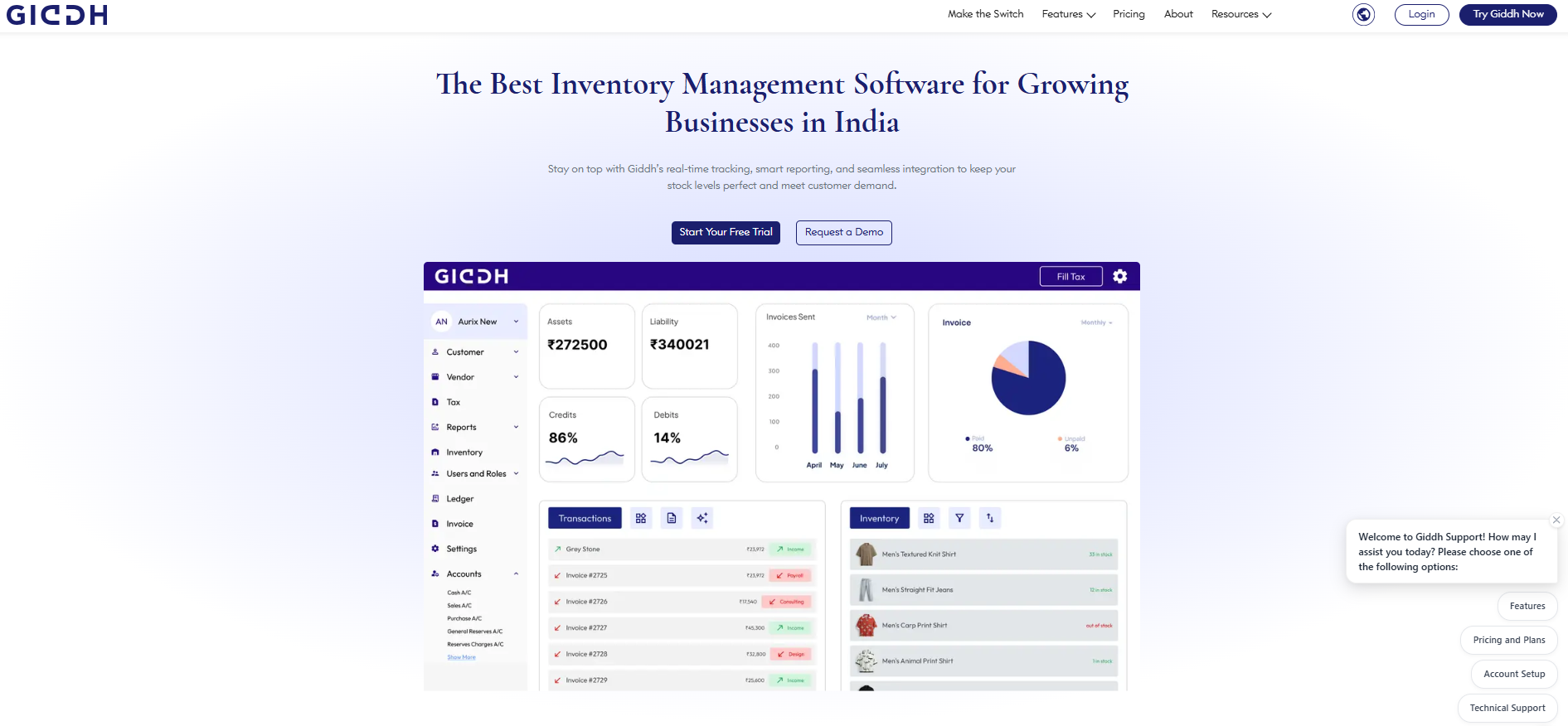
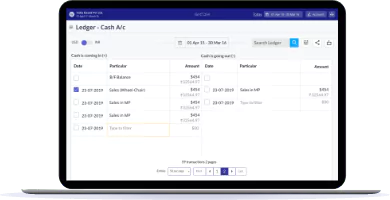
Businesses aiming to eliminate manual reconciliation between finance and inventory operations need a platform that seamlessly connects the two systems. Giddh accounting software is designed to bring accounting and inventory workflows into a single centralized environment, keeping operational and financial data synchronized automatically.
Instead of managing separate tools for accounting and stock tracking, businesses can manage both processes within a single platform. This integration helps reduce errors, speed up reporting, and improve overall operational efficiency.
What Distinguishes Giddh for the Executive Buyer
Capability | Business Impact |
|---|---|
Live inventory-to-accounting sync | Every sale or purchase updates ledger entries in real time — no batch jobs, no delays. |
Automated journal entries and P&L | Finance teams get up-to-date reports instantly, reducing close cycles from days to hours. |
Multi-location and multi-currency support | Manage warehouses, stores, and international operations from one dashboard. |
GST and compliance automation | Automatically handles GSTR-1, GSTR-2, and GSTR-3B, reducing compliance risks. |
Tally migration support | Smooth data migration from legacy systems without operational disruption. |
Shopify and platform integrations | Sync orders, inventory, and payments automatically across ecommerce platforms. |
Cloud access with AWS-grade security | Secure, encrypted data accessible from anywhere for distributed teams. |
100+ companies under one subscription | Manage multiple entities from a single account with role-based access controls. |
For companies managing both financial operations and inventory movement daily, integrated platforms like Giddh accounting solution provide the foundation needed to maintain accuracy, streamline processes, and scale operations efficiently.
Conclusion
Managing accounting and inventory separately creates operational challenges. Manual reconciliation leads to data inconsistencies, reporting delays, and unnecessary administrative workload.
Integrated accounting and inventory management software solves these issues by automating workflows and synchronizing financial and inventory data.
Businesses gain real time insights into stock levels, revenue performance, and operational efficiency.
Automation not only improves accuracy but also supports business growth. Companies can handle increasing transaction volumes and expanding product catalogs without operational bottlenecks.
Solutions such as Giddh Accounting Software help businesses centralize financial and inventory operations in one cloud platform.
If your business is dealing with disconnected systems and manual workflows, exploring integrated automation tools could significantly improve efficiency.
Start a free trial to experience how automated accounting and inventory workflows simplify business operations.
 Download
  Download