How the Evolution of Accounting Drives Business Growth
According to a recent study, the Global Cloud Accounting Software Market size was valued at USD 6089.23 million in 2025 and is poised to grow from USD 6466.77 million in 2026 to USD 11167.56 million by 2035.
These statistics underscore a key shift in financial management: the evolution of accounting from legacy, desktop-based methods to cutting-edge cloud-based software. As businesses of all sizes continue to embrace technology, accounting practices are rapidly transforming, enabling smarter financial management.
This transformation goes beyond just software updates. It’s about how businesses approach financial data management, security, and decision-making. What does the future hold for accounting? How can businesses ensure they're prepared to keep up with this evolution?
In this blog, we’ll explore the evolution of accounting systems, how they drive business growth, and key things to consider before making the switch to a new accounting solution.
Accounting in a Pre-Digital Era
Before the rise of modern accounting software, businesses relied heavily on manual accounting systems and spreadsheet-based solutions. These systems were cumbersome, error-prone, and time-consuming. Financial data had to be entered manually, reconciled, and reported without automation tools. The process was inefficient and error-prone, resulting in costly mistakes and delays.
-
Manual Processes: Businesses often used ledgers, journals, and spreadsheets to track financial records. The entire process was error-prone, especially when calculations had to be done manually.
-
Limited Accessibility: Accounting data was stored on individual computers or in physical files, making collaboration difficult, especially for teams working remotely or in different locations.
-
Slower Decision-Making: With outdated systems, generating real-time financial reports was nearly impossible. This slowed decision-making, making it harder for businesses to react quickly to market changes.
While these methods were necessary in their time, they were simply not scalable or efficient enough to handle the growing complexity of modern businesses.
How the Evolution of Accounting Drives Business Growth
The evolution of accounting is not just about adopting new tools—it's about embracing a complete shift in how businesses manage their financial data. Over the years, accounting practices have evolved from paper-based systems to complex desktop software and now to cloud-based solutions. Each step in this journey has had a profound impact on business growth, improving efficiency, security, and decision-making.
The introduction of online accounting systems, particularly cloud-based solutions, has created new opportunities for businesses to streamline operations and remain competitive. Real-time data access, automated updates, and improved collaboration between teams have transformed accounting into a strategic function that drives business performance.
Here’s how the evolution of accounting directly contributes to business growth:
-
Increased Efficiency: Automated features such as invoicing, tax calculations, and reconciliation save time, enabling businesses to focus on strategic goals rather than manual processes.
-
Better Decision-Making: Real-time financial insights enable businesses to make informed decisions, identify trends, and plan for growth more effectively.
-
Improved Cash Flow Management: Cloud accounting systems enable businesses to track and manage cash flow efficiently, preventing payment delays and missed opportunities.
-
Enhanced Security: Cloud accounting solutions offer encryption, secure data storage, and backup, ensuring financial data is protected and accessible at any time without risk of data loss.
-
Scalability: Cloud-based accounting systems grow with the business, making it easier to scale as new requirements emerge. Whether you're adding employees, expanding into new markets, or increasing your product line, your accounting system can keep up.
The move to digital accounting is no longer optional for businesses aiming for growth. As accounting systems evolve, so do the opportunities for businesses to improve their financial management and stay ahead of competitors.
The Rise of Online and Cloud-Based Accounting Software
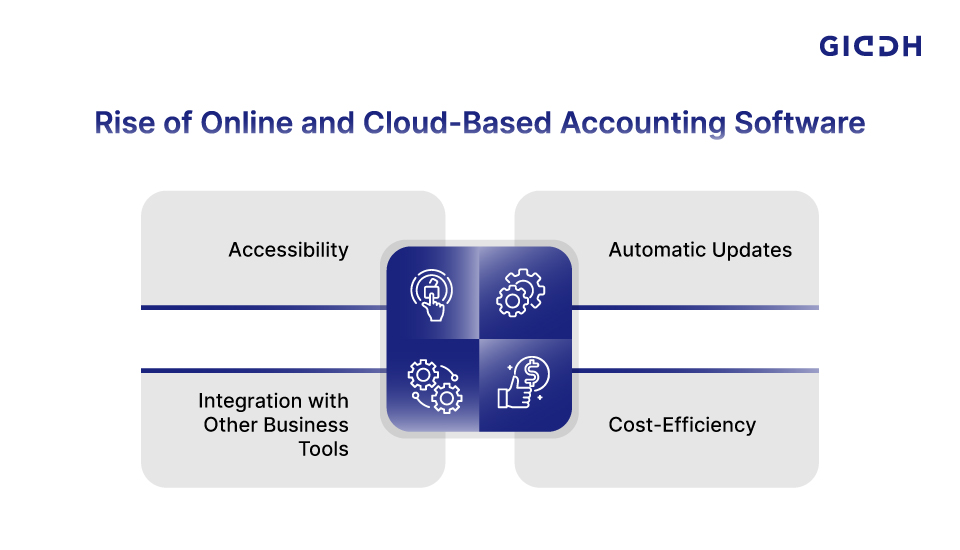
The evolution of accounting software has primarily been driven by the shift from traditional, desktop-based systems to cloud-based solutions. Cloud accounting software offers numerous advantages that were previously unavailable with older accounting tools. Let’s break down some of the most significant benefits of cloud-based accounting software.
-
Accessibility:
-
Access Anywhere, Anytime: Cloud accounting software allows businesses to access their financial data from any device with an internet connection.
-
Remote Work Flexibility: This feature is especially beneficial for companies with remote teams or those that operate in multiple locations.
-
Increased Collaboration: Teams can collaborate in real time, ensuring a seamless flow of information regardless of geographic barriers.
-
-
Automatic Updates:
-
No Manual Upgrades Needed: Unlike traditional desktop accounting software, cloud solutions automatically update without requiring user intervention.
-
Stay Compliant: Automatic updates ensure that businesses remain compliant with the latest financial regulations and accounting standards.
-
Reduced Downtime: Businesses no longer face the disruptions that often come with manual updates or system upgrades.
-
-
Integration with Other Business Tools:
-
Seamless Connectivity: Cloud-based accounting software integrates seamlessly with other business tools, including CRM, payroll, and inventory systems.
-
Improved Workflow: This integration reduces data silos and streamlines workflows across various departments.
-
Better Data Synchronization: Real-time syncing ensures data across all systems is accurate and up-to-date.
-
-
Cost-Efficiency:
-
Affordable Subscription Models: Many cloud accounting platforms use subscription-based pricing, which is more affordable for small businesses than traditional systems that often carry hefty upfront costs.
-
No Hardware Costs: Cloud-based systems eliminate the need for businesses to invest in costly hardware or maintain IT infrastructure.
-
Scalable for Growth: As your business grows, cloud solutions are easy to scale without incurring significant additional expenses.
-
Cloud-based accounting software is increasingly popular, particularly among small businesses seeking flexible, affordable, and secure solutions to manage their finances efficiently. The ability to access financial data from anywhere, combined with seamless integration and cost-effective pricing, makes cloud accounting an essential tool for modern businesses.
7 Factors to Consider In Changing Accounting Systems
Switching to a new accounting system can be a significant decision that impacts all areas of your business. While the evolution of accounting presents numerous benefits, it's crucial to approach the transition thoughtfully. Here are seven essential things to consider before changing your accounting system:
Factor | Description | Why It Matters |
|---|---|---|
| Identify your specific accounting needs such as real-time reporting, multi-currency support, and tax management. | Helps ensure the chosen system aligns with business goals and future growth. |
| Evaluate how easily data can be migrated and whether training will be required for your team. | A smooth transition reduces downtime and helps teams adopt the new system quickly. |
| Ensure the system meets financial regulations and provides strong security features like encryption and backups. | Protects sensitive financial data and prevents legal or tax issues. |
| Check if the system can scale by adding users, features, or modules as your business grows. | Ensures the software supports long-term growth without major system replacements. |
| Assess upfront and ongoing costs such as subscriptions, training, additional features, and IT support. | Helps avoid unexpected expenses and supports better budgeting decisions. |
| Check if the system integrates with tools like CRM, payroll, and inventory systems. | Integration improves data flow across systems and reduces manual work. |
| Ensure the software is easy to use for both accountants and non-technical team members. | User-friendly systems improve adoption, reduce training time, and increase productivity. |
Giddh: A Modern Accounting Solution for the Future
As cloud-based accounting software becomes the norm, Giddh stands out as a leading example of modern accounting solutions. This platform simplifies accounting, streamlining everything from invoicing to financial reporting.
Key Features | Description | Benefits |
|---|---|---|
Cloud-Based Efficiency | Access financial data anytime and from any device with an internet connection. | • Remote access for teams |
Data Security | Strong encryption and cloud storage to protect financial data. | • Protects sensitive financial data |
Real-Time Insights | Provides real-time financial insights such as cash flow, expenses, and profit. | • Better decision-making |
Ease of Use | Intuitive interface requiring minimal training. | • Easy for non-accountants |
Invoicing & Billing | Automates invoice generation and payment tracking. | • Faster invoicing |
Tax Management | Calculates and manages taxes according to current regulations. | • Fewer tax errors |
Multi-Currency Support | Supports international transactions with multiple currencies. | • Simplifies global transactions |
Integration with Other Tools | Integrates with CRM, payroll, and inventory systems. | • Streamlined operations |
Customizable Reports | Generate detailed financial reports tailored to business needs. | • Tailored financial insights |
Collaboration & User Access | Enables team collaboration with role-based access controls. | • Secure collaboration |
By offering an all-in-one solution for managing finances, Giddh exemplifies the evolution of accounting software, helping businesses streamline operations and stay ahead of the competition.

Final Thoughts: Embrace the Evolution of Accounting
The evolution of accounting systems has significantly changed how businesses manage their finances. From desktop-based software to powerful cloud-based solutions, the transformation has improved accessibility, security, efficiency, and scalability.
Businesses that embrace these changes are better positioned to make smarter decisions, increase profitability, and grow in an increasingly competitive market.
As you consider upgrading your accounting system, keep in mind the key factors that will drive the best decision for your business. Whether it's a more cost-effective solution, the ability to scale with growth, or enhanced security, choose the right accounting software to step into your business's success.
FAQs
1. What are the key differences between traditional and cloud-based accounting software?
Traditional accounting software is installed on desktops, which limits access and requires manual updates. Cloud-based software offers accessibility, automatic updates, and better security.
2. How does cloud accounting benefit small businesses?
Cloud accounting software is cost-effective, scalable, and user-friendly, making it an ideal solution for small businesses. It provides real-time financial insights and automatic updates with minimal upfront investment.
3. Is Giddh a good choice for small businesses?
Yes, Giddh is an excellent choice for small businesses. It offers cloud-based accessibility, real-time reporting, and strong security, all within an easy-to-use platform.
4. How do I migrate from traditional accounting software to cloud-based solutions?
Migrating to cloud-based accounting software involves transferring your financial data and training your team on the new system. Most cloud accounting providers, like Giddh, offer data migration services and support to ensure a smooth transition.
5. Why is the evolution of accounting important for business growth?
The evolution of accounting improves efficiency, decision-making, and scalability. It allows businesses to stay competitive by providing accurate, real-time financial data, which is essential for growth in today’s fast-paced market.
 Download
  Download