GST Rates by Product Category: Complete 2026 Cheat Sheet for India
As of 2026, India’s GST system remains one of the most complex tax structures globally. With rates changing annually and product categories being redefined, it’s no surprise that businesses and accountants often struggle to keep up. In fact, according to a recent survey, over 65% of small businesses in India cite difficulty in understanding and tracking GST rates as their most significant compliance challenge.
How can businesses remain on top of these frequent changes without spending hours searching through endless government documents? The solution lies in an accurate, easy-to-reference resource that categorizes GST rates by product type, including the necessary HSN codes for quick lookup.
In this blog, we offer an up-to-date 2026 GST Rates Cheat Sheet to simplify GST rate checking across every product category and help you ensure your business’s compliance.
What is GST and Why It’s Important for Your Business?
The Goods and Services Tax (GST) is a unified indirect tax system introduced in India in 2017 to streamline taxation. It replaced multiple taxes, such as VAT, service tax, and excise duty. GST is levied on the supply of goods and services, ensuring a seamless flow of credits across the production chain. For businesses, understanding GST is essential not just for compliance, but also for effective tax planning and reporting.
Why Tracking GST Rates is Critical for Your Business
With frequent updates and a vast array of product categories, the GST-compliant system demands businesses stay on top of rate changes. A simple mistake in applying the wrong rate can lead to accounting errors and possible penalties. For business owners and accountants, knowing the correct GST rate for every product category is crucial for maintaining accurate financial records, filing tax returns, and avoiding compliance issues.
The GST Rates Structure in India for 2026
In 2026, India continues to classify products and services into four primary GST rate categories:
-
5% – Essential items like food and medicines.
-
12% – Standard goods like certain textiles and some household items.
-
18% – Most services and many consumer goods.
-
28% – Luxury and sin goods like high-end cars and tobacco.
These rates are further broken down by product category, each requiring specific HSN (Harmonized System of Nomenclature) codes. The use of these codes is crucial for identifying and categorizing products correctly under GST.
GST Rate Categories by Product Type in 2026
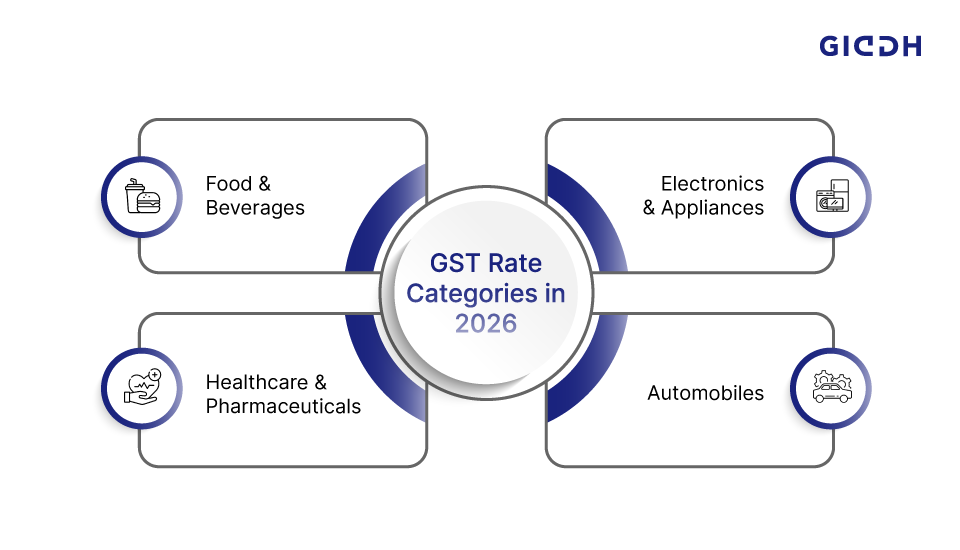
Here’s an overview of how GST rates apply to different product categories in 2026:
-
Food & Beverages
-
5% for essential food items like fruits, vegetables, and spices.
-
12% for processed foods, packaged snacks, and beverages.
-
-
Electronics & Appliances
-
18% for most home appliances like refrigerators, washing machines, and air conditioners.
-
28% for luxury electronics such as high-end smartphones and gadgets.
-
-
Healthcare & Pharmaceuticals
-
5% for essential medicines and health supplements.
-
12% for medical equipment and devices.
-
-
Automobiles
-
18% for electric vehicles (EVs) and hybrid cars.
-
28% for luxury cars and SUVs.
-
Each of these categories has further nuances that businesses need to understand to remain compliant. The HSN code simplifies this process by providing a standardized system for identifying products.
How to Check GST Rates with HSN Codes
The HSN code system helps businesses identify the exact GST rate applicable to their products. Every product in India is assigned a unique HSN code, which links it to a specific GST rate.
To check the GST rate for any product:
-
Identify the HSN code for the product.
-
Use an online GST search tool or government portal to match the HSN code to the correct GST rate.
-
Cross-check the GST rates chart or GST rate check tool to ensure accuracy.
Top Benefits of Using HSN Codes for GST Compliance
-
Avoid Errors: HSN codes minimize human errors when categorizing products and applying the correct GST rate.
-
Simplified Audits: Accurate classification of products using HSN codes ensures smooth tax audits and avoids penalties.
-
Real-Time Updates: GST rates are dynamic, and the use of HSN codes ensures your business stays compliant with the latest changes.
By leveraging online accounting tools that integrate HSN codes with GST rates, businesses can ensure more accurate filings and better tax management.
The Ultimate 2026 GST Rates Cheat Sheet
Our cheat sheet provides a quick-reference guide to the latest GST rates by product category for 2026. It includes:
-
A comprehensive list of product categories and their corresponding GST rates.
-
HSN codes linked to each product for easy lookup.
-
A visual chart that breaks down GST rates by category, making it easier to navigate.
Whether you are a small business owner or an accountant, this cheat sheet will serve as your go-to resource for quick GST rate checks.
How to Streamline GST Management with Giddh
Managing GST compliance can be challenging for businesses, especially with frequent rate changes and complex regulations. Giddh, a cloud-based accounting platform, simplifies this process with its robust features designed for seamless GST management.
Key Features of Giddh for GST Compliance
-
Real-Time GST Updates
Giddh automatically updates your system with the latest GST rates, ensuring you always apply the correct tax rate for your products. -
HSN Code Integration
Easily match products with their correct HSN codes, reducing the risk of misclassification and ensuring accurate tax filing**.** -
GST Filing Automation
Giddh automatically generates your GST returns and allows you to file them directly through the platform, saving time and reducing errors. -
GST Reconciliation & Reports
Simplify GST reconciliation by comparing sales and purchase transactions with your returns. Detailed reports help with audits and reviews. -
Invoicing & Tax Calculation
Automatically calculate GST on invoices based on product categories and HSN codes, ensuring GST compliance in every transaction. -
Multi-Entity Support
Manage GST for multiple business entities or locations under one account, applying the correct rates for each region.
Why Choose Giddh?
-
Saves Time: Automated accounting processes like filing and reconciliation.
-
Ensures Accuracy: Real-time updates and HSN integration minimize errors.
-
Easy to Use: Simple, intuitive interface for users at all levels.
-
Scalable: Perfect for small businesses or larger multi-entity operations.
Giddh is your all-in-one solution for efficient GST management, allowing you to focus on growing your business while we handle the complexity of tax compliance.

Common Mistakes to Avoid When Dealing with GST Rates
-
Misclassifying Products: One of the most common mistakes businesses make is applying the wrong GST rate due to incorrect product categorization.
-
Using Outdated Rates: GST rates change periodically, and using outdated information can lead to compliance issues.
-
Improper HSN Code Mapping: Incorrect HSN code assignments can lead to tax mismatches and penalties.
Tips to Avoid These Mistakes:
-
Regularly update your GST resources to ensure you’re using the latest rates.
-
Double-check HSN codes for each product.
-
Use reliable tools like Giddh to automate updates and filings.
Conclusion
Understanding GST rates and their HSN codes is critical for Indian businesses looking to stay compliant and avoid costly errors. With the constantly changing nature of GST rates, relying on accurate resources, such as our 2026 GST Rates Cheat Sheet, can save time and effort. Moreover, using tools like Giddh accounting software streamlines tracking and managing GST, ensuring your business is always up-to-date.
Stay on top of GST changes and streamline your business’s tax compliance with free 2026 GST Rate Cheat Sheet. This will keep your operations efficient and error-free!
Frequently Asked Questions
1. How do I find the GST rate for a specific product?
To find the GST rate, search for the HSN code for the product. Use an online GST rate checker or the government’s official portal to match the HSN code to the correct GST rate.
2. Can GST rates change in the middle of a financial year?
Yes, the government frequently revises GST rates. These changes are typically announced during the budget or through notifications. Businesses should regularly check for updates.
3. How can Giddh help with GST management?
Giddh helps by providing real-time GST rate updates, integrating HSN codes for easy classification, and automating GST filing to ensure timely and accurate returns.
4. Is there any penalty for applying the wrong GST rate?
Yes, misapplying the wrong GST rate can lead to penalties during audits. Therefore, businesses must ensure they are using the correct rates and HSN codes at all times.
 Download
  Download