How Software Improves Balance Sheet Reporting Accuracy
Recent reports indicate that nearly 40% of businesses still rely on manual processes for financial reporting, resulting in frequent errors and compliance risks. Financial professionals know that accuracy in balance sheet reporting is a cornerstone of sound business operations.
Yet, as businesses scale, manual systems simply can't keep up. Financial controllers and CFOs of growing companies are responsible for managing complex reports under pressure to ensure timely, accurate information while keeping up with evolving regulations.
The introduction of accounting solutions for balance sheet management has become the answer to these challenges. By automating data entry, providing real-time updates, and ensuring compliance, modern software tools are revolutionizing financial reporting.
Are you ready to streamline your balance sheet reporting and reduce human errors? Let’s delve into how this technology is transforming the accuracy and efficiency of financial reporting.
What Is Balance Sheet Reporting and Why Is It Important?
Balance sheet reporting involves creating a snapshot of a company’s financial health by tracking its assets, liabilities, and equity over a specific period. This key financial statement provides insight into a company's financial position, enabling stakeholders to assess the business's stability and growth potential.
Importance in Financial Management
Balance sheet reporting helps track a business's overall financial health. It’s a tool for making informed business decisions, securing investments, and complying with legal and regulatory standards. Any discrepancies in these reports can lead to poor decision-making, missed opportunities, and even legal consequences.
Problems with Traditional Methods
Manual balance sheet reporting is prone to errors due to human intervention, especially when data is entered manually into spreadsheets or outdated systems. These errors can lead to inaccurate financial statements, which might not only harm decision-making but also affect compliance with regulatory standards.
With traditional reporting methods, data consistency can be a challenge, leading to discrepancies across reports and prolonged reporting cycles. The question arises: How can companies ensure their balance sheets reflect the true financial state of the business?
Challenges in Balance Sheet Reporting
Despite technological advancements, many organizations still rely on outdated financial reporting methods. Here are the key challenges:
Manual Data Entry
Manual data entry increases the risk of errors—mistyped figures or miscalculated totals are common. Additionally, the process is time-consuming and often delays report generation.
Lack of Real-Time Insights
Outdated systems fail to provide real-time insights into a company's financial position. This delay can impede timely decision-making, especially when companies need up-to-date data to evaluate business performance.
Compliance Risks
Financial regulations constantly evolve, and manual systems struggle to keep up with these changes. Companies using manual methods risk submitting inaccurate reports that don't comply with the latest regulatory requirements.
Issues with Outdated Software
Many organizations still use legacy systems, which may not be capable of handling complex data or integrating with modern tools. These outdated systems can create bottlenecks in reporting and delay critical audits.
How Software Solutions Improve Balance Sheet Reporting Accuracy
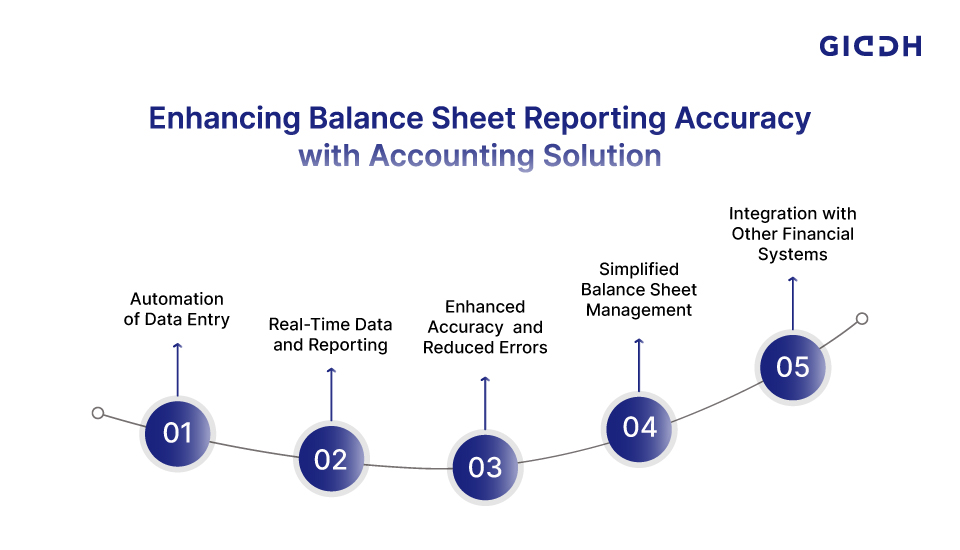
Modern financial software can address several challenges finance teams face when managing balance sheet reports. By automating manual processes and providing real-time insights, businesses can significantly improve the accuracy and efficiency of their financial reporting. Below are key ways in which software solutions enhance balance sheet reporting:
Automation of Data Entry
Automation reduces the need for manual data entry, which is often error-prone and inconsistent. When financial data is entered automatically from reliable sources such as bank feeds, invoice management, or accounting platforms, it helps ensure the data is accurate, complete, and up-to-date.
-
Reduces Human Error: Automated data entry minimizes the risk of common mistakes, including data entry errors, incorrect calculations, and transposed numbers.
-
Faster Reporting Process: By automating data entry, teams no longer have to manually enter data or cross-reference spreadsheets, saving time and accelerating the reporting cycle.
-
Improved Consistency: Automation ensures that data is consistent across all financial statements, making it easier to generate accurate reports without discrepancies.
Real-Time Data and Reporting
One of the biggest challenges with traditional financial systems is the lack of real-time insights. Many businesses rely on outdated data or reports that are generated at the end of a reporting period. Modern software tools, however, provide real-time access to financial data, giving businesses a clear view of their balance sheet status at any moment.
-
Up-to-Date Financial Data: Real-time reporting ensures that financial data is always current, providing teams with an accurate snapshot of the company’s financial health.
-
Timely Decision Making: With access to real-time financial reports, CFOs and financial controllers can make decisions based on the most accurate, up-to-date information available, enabling quicker, more informed actions.
-
Improved Financial Planning: Continuous updates make it easier to track trends and forecast future financial positions, helping businesses prepare for upcoming challenges or opportunities.
Enhanced Accuracy and Reduced Errors
Automation not only speeds up the process but also dramatically reduces the errors typically associated with manual data handling. Automated data processing eliminates the risk of human error, ensuring balance sheet reports are more reliable.
-
Accurate Calculations: Automated systems carry out complex calculations with precision, reducing the risk of mistakes that can arise from manual math errors.
-
Reduced Data Entry Mistakes: Automation eliminates the need to enter figures into multiple systems, ensuring all data points are consistent and aligned across platforms.
-
Error-Free Reporting: With all financial processes automated, businesses can produce error-free reports that meet the highest standards of accuracy, which is crucial for compliance and decision-making.
Simplified Balance Sheet Management
Managing balance sheets involves organizing large volumes of financial data and ensuring that all figures are correctly categorized. Modern software tools offer features that simplify this task, making it more efficient and less error-prone. This allows finance teams to spend less time on administrative tasks and more time on analysis.
-
Automated Categorization: Financial software automatically categorizes transactions, making it easier for teams to track balance sheet items such as assets, liabilities, and equity.
-
Easy Data Validation: Advanced tools can validate data entries by cross-checking them against predefined rules, ensuring that no invalid or inconsistent data is entered.
-
Simplified Audits: With a streamlined balance sheet management process, auditing becomes less cumbersome. Finance teams can quickly identify discrepancies and address them before they become problems.
Integration with Other Financial Systems
Financial software often integrates seamlessly with other enterprise systems, such as accounting, ERP, and CRM systems. This ensures data flows smoothly between departments and platforms, reducing the need for manual data entry or for transferring information across systems.
-
Consistency Across Platforms: By integrating various financial systems, businesses can ensure the same data is reflected across platforms, eliminating the risk of discrepancies between reports.
-
Automated Data Transfers: Integration enables automatic data synchronization across platforms, reducing the time and effort required to manually update each system.
-
Comprehensive Reporting: With integrated systems, financial data from different areas (such as payroll, revenue, and expenses) can be consolidated into a single report, providing a clearer picture of a company's financial position.
Why Traditional Methods Are Falling Short
Inefficiency of Manual Processes
Manual reporting processes are time-consuming, labor-intensive, and error-prone. Without automation, finance teams spend countless hours cross-referencing spreadsheets and entering data manually—activities that can easily lead to delays.
Data Inconsistencies
Using multiple systems or files for tracking financial data can lead to inconsistencies. Without a centralized platform, reconciling data from different sources can be cumbersome and error-prone.
Challenges in Collaboration
Traditional methods often rely on static reports or spreadsheets that are difficult to collaborate on in real-time. When teams can’t access up-to-date information or collaborate efficiently, the decision-making process slows and becomes less effective.
How Giddh Can Help Improve Your Balance Sheet Reporting
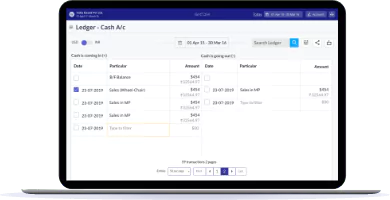
Giddh is a cutting-edge accounting software that simplifies balance sheet management by automating reporting, enhancing accuracy, and ensuring compliance.
Key Features of Giddh
-
Automated Balance Sheet Reporting: Reduces manual intervention by generating accurate reports automatically.
-
Real-Time Financial Insights: Offers up-to-date financial data, helping teams make informed decisions faster.
-
Compliance with Regulations: Ensures reports meet the latest regulatory standards, minimizing compliance risk.
-
Collaborative Tools: Enable easy sharing of reports with your team to ensure real-time alignment and collaboration.
Discover how Giddh can streamline your balance sheet reporting process and improve your financial reporting accuracy—request a demo today!
Benefits of Using Balance Sheet Software
Time Savings
Automating balance sheet reporting allows finance teams to save hours of manual labor, freeing up resources for more strategic tasks.
Improved Decision-Making
Real-time data and accurate reports provide CFOs and financial controllers with deeper insights, enabling faster, more informed decision-making.
Better Compliance and Accuracy
By using real-time online accounting software that updates to reflect changes in financial regulations, businesses can ensure their balance sheet reports are compliant and accurate.
Scalability
Financial software grows with your business. As you expand, your reporting needs will become more complex, and the right software can handle those increasing demands without additional overhead.
How to Choose the Right Software for Balance Sheet Reporting
Key Features to Look For
When selecting software for balance sheet reporting, prioritize features like real-time updates, automation, data integration, and regulatory compliance. These elements will ensure that your reports are both accurate and timely.
Cost and Value Consideration
While free software options exist, they often lack the comprehensive accounting features needed for growing businesses. Investing in paid software can provide greater scalability and functionality, offering long-term value.
Free vs. Paid Options
Free software may work for small businesses with simple needs, but as your company scales, it’s worth considering a paid solution that offers enhanced reporting, collaboration tools, and compliance features.
Conclusion
Accurate balance sheet reporting is essential for businesses to make informed decisions, comply with regulations, and track their financial health. The transition from manual reporting systems to automated software solutions brings significant benefits, including improved accuracy, efficiency, and compliance.
Implementing a comprehensive financial software solution like Giddh can streamline reporting, reduce errors, and keep your business on track. For CFOs and financial controllers looking to improve reporting accuracy and stay ahead of compliance requirements, the solution lies in embracing modern financial software.
Try Giddh for free to transform your balance sheet reporting and improve financial accuracy. Request a demo today and experience the future of financial management.
FAQ
1. What is the difference between balance sheet reporting and balance sheet auditing?
Balance sheet reporting involves preparing and presenting the financial data of an organization, while balance sheet auditing is the independent review and verification of these reports to ensure accuracy and compliance.
2. How does balance sheet software improve accuracy?
Balance sheet software automates data entry, minimizes human error, and provides real-time updates, ensuring that all financial data is accurate and compliant with regulations.
3. Can I use free balance sheet software for my business?
Free balance sheet software can be useful for small businesses with simple reporting needs. However, for larger organizations, investing in paid software that offers advanced features and scalability is usually more beneficial.
 Download
  Download