Why Businesses Fail To Survive: 10 Critical Reasons and Proven Prevention Strategies

About 20 percent of small businesses fail within their first year, and roughly half shut down within five years, according to the U.S. Bureau of Labor Statistics. The long term survival rate drops even further beyond the ten year mark.
If failure is so common, the real question is this. Are businesses collapsing because of market conditions, or because of decisions made internally?
Most founders blame competition, economic slowdowns, or funding challenges. Yet data consistently shows that internal weaknesses drive the majority of closures. Cash flow mismanagement, unrealistic business plans, and poor financial visibility top the list of reasons for business failure across industries.
Understanding the real reasons businesses fail is not about fear. It is about control. The companies that survive are not lucky. They are disciplined, informed, and financially aware.
Let us break down the 10 reasons businesses fail and how to prevent them.
Business Failure Statistics That Every Founder Should Know
Before diving into the 10 reasons businesses fail, consider these realities:
-
Around 50 percent of small businesses fail within five years.
-
Cash flow issues contribute to nearly 82 percent of closures in early stage ventures.
-
Poor management and lack of planning consistently rank among top reasons for business failure.
These numbers confirm one thing. Failure is rarely sudden. It builds quietly through operational gaps and financial blind spots.
For Indian businesses, compliance complexity, GST management, and inconsistent bookkeeping add another layer of risk. This is where structured accounting systems become critical.
10 Proven Reasons Businesses Fail
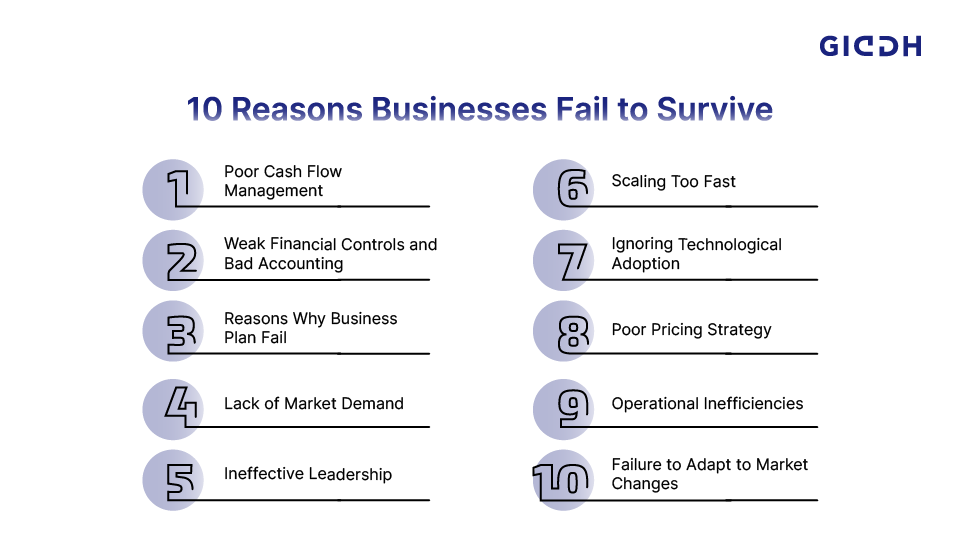
Below are the most common and preventable reasons businesses fail across industries and regions.
Poor Cash Flow Management
Revenue does not equal liquidity. Many profitable companies collapse because they cannot manage working capital.
Common mistakes include:
-
Extending excessive credit to customers
-
Ignoring receivables aging
-
Overestimating future revenue
Without clear cash visibility, businesses struggle to pay vendors, salaries, and taxes. This remains one of the primary reasons small businesses fail.
Weak Financial Controls and Bad Accounting
Financial mismanagement is among the most critical reasons for business failure.
Warning signs:
-
Manual bookkeeping
-
Delayed reconciliations
-
Inaccurate GST filings
-
No monthly financial review
Many founders assume accountants will handle everything. However, lack of oversight creates risk. Choosing the best accounting software in India can dramatically improve transparency.
Modern cloud accounting tools provide:
-
Real time financial dashboards
-
Automated compliance
-
Bank reconciliation
-
Multi user access
When leaders lack financial clarity, strategic decisions suffer.
Reasons Why Business Plan Fail
A business plan often looks impressive on paper but collapses under real market pressure.
Common planning errors include:
-
Unrealistic revenue projections
-
No contingency planning
-
Ignoring customer acquisition costs
-
Lack of measurable KPIs
One of the overlooked reasons why business plan fail is emotional forecasting. Founders assume best case scenarios instead of preparing for volatility.
A resilient plan includes downside analysis, cash runway calculation, and quarterly review cycles.
Lack of Market Demand
No amount of marketing can fix a product nobody needs.
Many reasons businesses fail trace back to poor validation.
Key mistakes:
-
Launching without customer research
-
Ignoring competitor positioning
-
Failing to test pricing elasticity
Market fit is not a one time achievement. It requires constant adjustment.
Ineffective Leadership
Leadership quality directly influences survival rates.
Poor leadership results in:
-
High employee turnover
-
Misaligned teams
-
Slow decision making
Among the leading reasons small businesses fail is founder dependency. When everything revolves around one person, scalability becomes impossible.
Strong leadership requires delegation, systems, and accountability frameworks.
Growth feels positive, but uncontrolled expansion is dangerous.
Risks include:
-
Hiring beyond revenue capacity
-
Over investing in inventory
-
Expanding to new markets prematurely
Rapid growth without financial structure is one of the hidden reasons for business failure.
Sustainable scaling demands disciplined forecasting and monthly financial reviews.
Scaling Too Fast
Growth feels positive, but uncontrolled expansion is dangerous.
Risks include:
-
Hiring beyond revenue capacity
-
Over investing in inventory
-
Expanding to new markets prematurely
Rapid growth without financial structure is one of the hidden reasons for business failure.
Sustainable scaling demands disciplined forecasting and monthly financial reviews.
Ignoring Technological Adoption
Manual processes slow decision making.
Businesses that resist digital transformation often struggle with:
-
Inconsistent reporting
-
Compliance penalties
-
Operational inefficiencies
Investing in the best accounting software in India reduces administrative friction and enhances visibility.
For reference, a list of accounting software in India includes options that support GST compliance, automated invoicing, and cloud based reporting. Selecting the right platform depends on scale, integration needs, and reporting complexity.
Poor Pricing Strategy
Underpricing erodes margins. Overpricing reduces demand.
Many founders fail to calculate:
-
True cost of goods
-
Overhead allocation
-
Customer acquisition cost
Pricing errors consistently appear among the top 10 reasons businesses fail.
Margin clarity protects sustainability.
Operational Inefficiencies
Inefficient workflows increase cost and reduce responsiveness.
Common issues:
-
No documented processes
-
Repeated errors
-
Delayed approvals
Operational friction gradually weakens competitiveness.
Efficiency audits every quarter can identify process bottlenecks before they escalate.
Failure to Adapt to Market Changes
Markets evolve. Consumer preferences shift. Regulatory requirements tighten.
Businesses that remain static risk obsolescence.
Adaptability requires:
-
Continuous market monitoring
-
Competitive analysis
-
Technology upgrades
-
Financial scenario modeling
Ignoring change remains one of the enduring reasons businesses fail across industries.
Why Reasons Small Businesses Fail Differ from Enterprises
Large corporations have buffers. Small businesses do not.
Primary vulnerabilities include:
-
Limited capital reserves
-
Lack of specialized departments
-
Founder centric operations
-
Weak internal financial controls
Because of tighter margins, even minor financial miscalculations can trigger closure.
This is why adopting structured accounting early is critical. The best accounting software in India enables small businesses to access enterprise level reporting without enterprise cost.
Financial Visibility as a Survival Strategy
A recurring pattern across all reasons businesses fail is lack of visibility.
When financial data is delayed or inaccurate:
-
Strategic decisions become reactive
-
Cash crises go unnoticed
-
Growth becomes unstable
Modern accounting platforms offer:
-
Real time profit and loss statements
-
Balance sheet tracking
-
GST reporting
-
Automated invoicing
Selecting from the list of accounting software in India requires evaluating:
-
Compliance support
-
Integration with banking systems
-
Data security
-
Scalability
Businesses that prioritize financial clarity significantly reduce preventable risk.
Choosing the Best Accounting Software in India
When evaluating the best accounting software in India, decision makers should assess:
-
Real time reporting capability
-
User friendly dashboards
-
Audit readiness
-
Cloud accessibility
Cloud based accounting solutions provide transparency and control, both of which directly address multiple reasons for business failure.

Giddh, a leading accounting software in India, offers these features and more, helping businesses streamline operations while ensuring compliance with the latest financial regulations. With Giddh, you can automate GST filing, manage cash flow, and gain real-time insights into your financial health, all from a single platform.
Key Features of Giddh:
-
Real-Time Financial Reporting: Access up-to-date financial data and generate reports instantly for better decision-making.
-
Automated GST Compliance: Stay compliant with GST regulations by automating GST returns and calculations.
-
Multi-User Access: Allow multiple team members to collaborate while maintaining control over permissions and data security.
-
Integrated Bank Reconciliation: Automatically reconcile your bank transactions with your accounting records to reduce errors and improve accuracy.
-
Customizable Invoices & Payments: Tailor invoices and payment reminders to fit your business needs, ensuring smooth cash flow management.
-
Cloud-Based Accessibility: Access your accounts anytime, anywhere, from any device with Giddh’s secure cloud-based platform.
-
Audit-Ready Reports: Prepare your business for audits with easily accessible, detailed financial records and reports.
For growing SMEs, investing in structured accounting infrastructure is not optional. It is strategic risk management. Giddh makes this process seamless and scalable, ensuring that businesses can focus on growth without the looming risk of financial mismanagement.

Conclusion
Failure rarely happens overnight. It develops through small gaps in planning, leadership, and financial management. The most common reasons businesses fail are predictable and preventable. Poor cash flow control, weak business planning, ineffective leadership, and outdated accounting systems consistently appear across industries.
For Indian businesses, compliance complexity makes financial visibility even more critical. Selecting the best accounting software in India and establishing structured financial controls can eliminate several major reasons for business failure at once.
Understanding the 10 reasons businesses fail is only the first step. Acting on them through disciplined execution, transparent accounting, and continuous market adaptation separates sustainable companies from temporary ones.
Businesses that review their financial systems quarterly and adapt proactively significantly improve their survival odds.
FAQ Section
1. What are the main reasons businesses fail?
The primary reasons businesses fail include poor cash flow management, weak leadership, lack of market demand, bad accounting practices, and unrealistic business planning. Financial mismanagement remains the most consistent factor.
2. What are the top 10 reasons businesses fail?
The 10 reasons businesses fail include cash flow issues, bad accounting, weak business plans, lack of demand, poor leadership, rapid scaling, outdated technology, pricing errors, operational inefficiencies, and failure to adapt.
3. Why do small businesses fail within five years?
Reasons small businesses fail within five years include limited capital, inconsistent revenue, poor financial controls, and lack of structured planning. Smaller firms lack financial buffers compared to large enterprises.
4. What are common reasons for business failure in India?
Common reasons for business failure in India include GST compliance errors, cash flow gaps, informal accounting systems, and poor financial visibility. Adopting the best accounting software in India reduces these risks.
5. Which is the best accounting software in India?
The best accounting software in India depends on business size and complexity. Key features to evaluate include GST compliance, automation, real time reporting, and scalability. Businesses should compare options from a reliable list of accounting software in India before selecting a solution.

 Download
  Download